
At the International Press Centre, a Lesson in Staying Alive Online
In Lagos, students are being taught that digital safety is not an afterthought — it is a survival skill.
BY OLUWASEYI ELIZABETH JIMOH
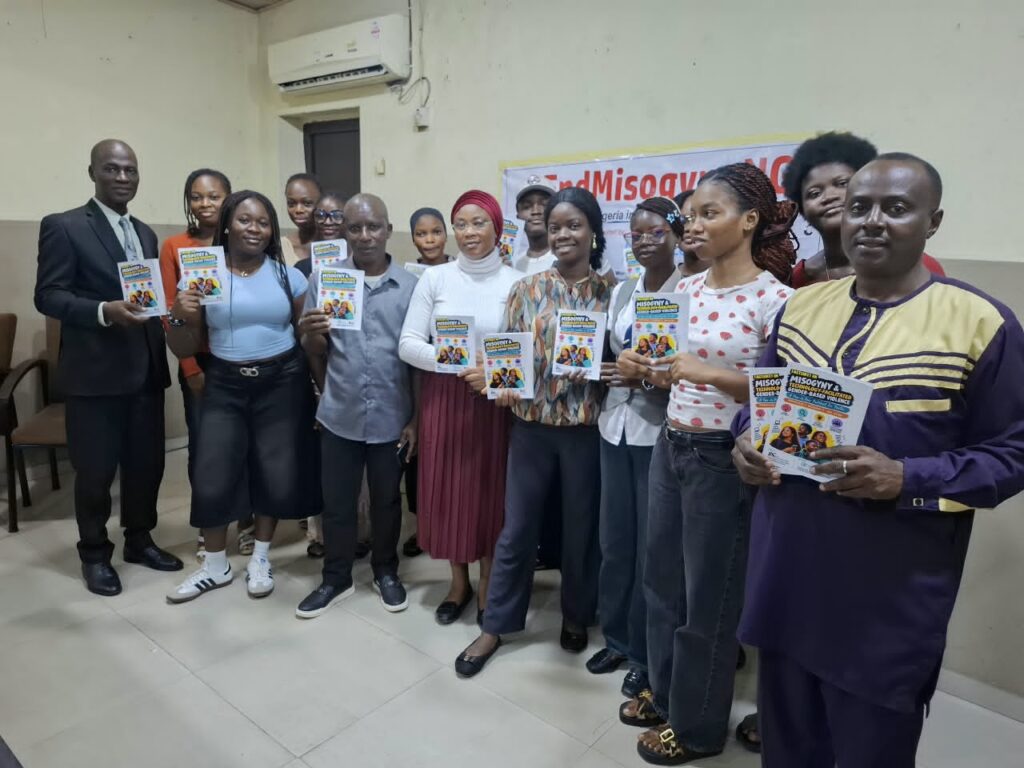
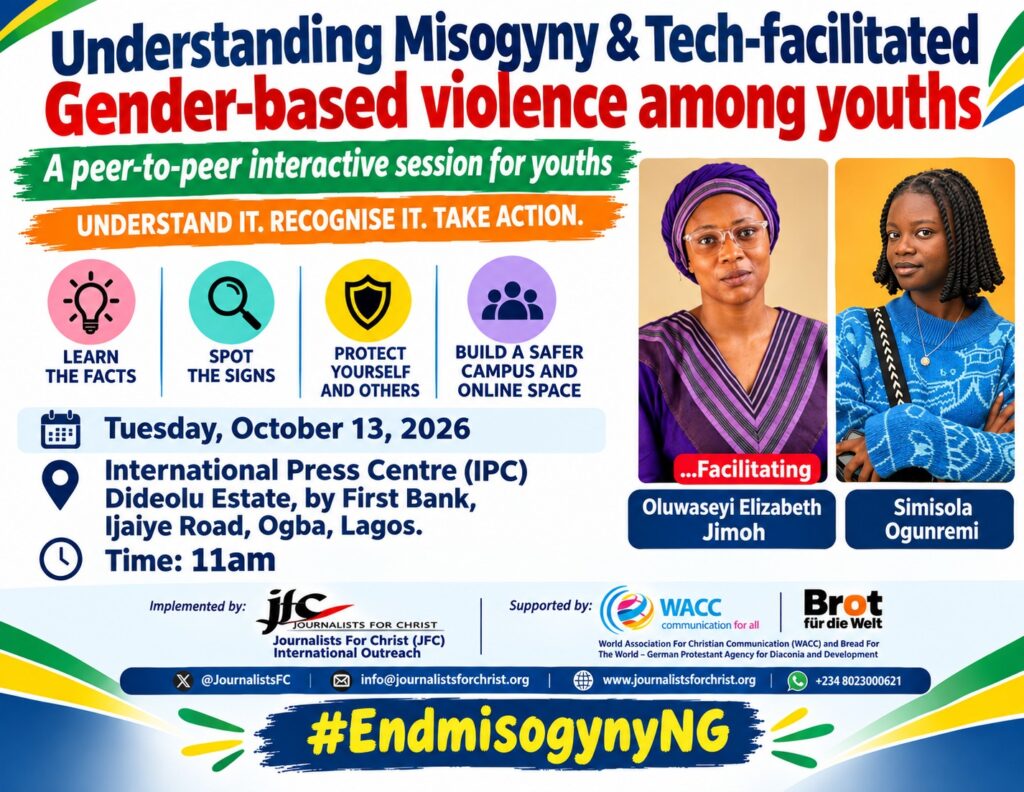
The room at the International Press Centre in Lagos was full of undergraduates — from Lagos State University, the University of Lagos, and other tertiary institutions across the state — who had come for what, on paper, sounded like another campus sensitization programme. The flyers said misogyny and technology-facilitated gender-based violence. The conversation that followed was about something more elemental: how to remain fully human in a digital world that often tries to make you less so.
The programme, convened by Journalists for Christ (JFC) with support from the World Association for Christian Communication (WACC) and Brot für die Welt, was built around a simple document: a factsheet on understanding, recognising, and responding to misogyny and technology-facilitated gender-based violence. Copies were handed out, but the real text was in the room.
Oluwaseyi Jimoh of Lagos State University told students to stop confusing silence with safety.
“The moment we begin to silence someone because of their gender, we begin to deny them the freedom to be fully human,” she said.
It was the line that quieted the room. Jimoh’s argument was not abstract. She walked the students through the mechanics of online abuse — how it escalates, how it isolates — and gave them a protocol that sounded less like media literacy and more like first aid: Do not feel pressured to respond to an attack. Block and report abusive accounts. Secure your digital accounts. Confide in someone you trust. Seek support, and seek it early.
She named the forms this violence takes, including sextortion and blackmail, and warned that the danger is not hypothetical. To illustrate, she invoked a case that has haunted digital safety conversations on both sides of the Atlantic — that of a 17-year-old Canadian boy who reportedly died after being exploited by two Nigerian brothers. The point was not sensationalism; it was consequence. Sextortion can be fatal. The shame that keeps victims silent is part of the trap.
“Digital platforms offer opportunities for learning, communication and economic advancement,” Jimoh reminded them. “But they can also expose you to abuse when safety precautions are neglected.” Her counsel was pragmatic, not moralistic: prioritise your safety over your pride. Speak, rather than suffer in silence.
Simisola Ogunremi of the University of Lagos picked up where Jimoh left off, shifting the focus from what to do to where to go. She challenged participants to name, off the top of their heads, one organization or support channel they could contact in an emergency — when a photo is leaked, when harassment turns to stalking, when privacy is breached. The hesitation in the room was the point.
Ogunremi urged students to familiarise themselves with reporting channels and support systems before their safety is threatened, not after. Knowing where to go, she suggested, is itself a form of protection.
Together, the facilitators dissected the more ordinary, daily forms of misogynistic behaviour that live online — the pile-ons, the unsolicited sexual content, the policing of women’s voices — and encouraged participants to recognise them as abusive conduct, not just “cruise” or “banter.” They spoke about digital consent, about responsible online behaviour, about what it would take to make campus communities safer, both on and offline.
The programme ended the way most advocacy does now — with a hashtag meant to travel further than the room: #EndMisogynyNG. It was a call to amplify the campaign for safer digital spaces and for a collective refusal of misogyny in all its forms.
Students left with the factsheet in their bags and an instruction that was as old as journalism and as new as the internet: share what you know. Tell a peer how to stay safe. Tell another how to recognise abuse. Tell another where to get help.
Because in the end, the internet will not make itself safer.


Comments