
THE POET IN KIGALI
On jollof, genocide, and what it means to be a moving antenna.
A Literary Spotlight by LightRay!
On a Monday evening in late September, Godson Osarenren landed at Kigali International Airport with a suitcase full of poems and a question he has carried for years: what happens when a country decides that identity is a weapon?
For Osarenren — the Benin City-born poet, founder of Naija Poetry Fest, and a man who thinks about ethnicity the way other people think about the weather — Rwanda had never been an abstraction on a map. It was a warning. A case study discussed in classrooms, in beer parlours, in late-night arguments about Nigeria. What happens when prejudice becomes policy.
So when the invitation came to bring Nigerian writing to the Umurage International Book and Art Festival, themed this year, somewhat ominously and somewhat optimistically, “Intelligent Tools, Human Voices,” it felt less like a literary gig and more like a summons.
The invitation had a pre-history. In February, his friend and father-figure Kede Aihie had asked him for a poem for a forthcoming book, From Ashes to Ambition: Paul Kagame – An Inspirational Leadership. He had written about Rwanda from afar. Now Rwanda wanted him to come and see it for himself.
He did not go alone. On September 29th, a small, noisy delegation assembled at Murtala Muhammed International Airport in Lagos: Amarachukwu Chimeka of Purple Shelves; Dr. Ebidenyefa Tarila-Nikade; Servio Gbadamosi; Ndidi Chiazor Enenmor; and Osarenren himself. They flew Ethiopian through Addis Ababa, landed in Kigali around seven in the evening, and were met by the festival’s organizer, Mutesi Gasana, who checked them into the Hilltop Hotel and Country Club.
And then, immediately, a diplomatic incident.
Dinner was jollof rice. Or, at least, something that called itself jollof rice.
There was no pepper.
Any Nigerian will tell you that this is not a minor culinary footnote; it is a categorical failure. The delegation, jet-lagged but principled, convened an emergency intervention in the kitchen and instructed the chef on how to make jollof the Naija way. It was their first act of cultural diplomacy.

The second act began the next morning, and it was not funny at all.
At 9 a.m., they were taken to the Kigali Genocide Memorial. If you have never been, it is difficult to convey what the place does. It is not a museum in the conventional sense. It is a mass grave with explanatory text. More than a quarter of a million people are buried there. Across Rwanda, memorial sites hold more than a million.
Osarenren walked through rooms that document how quickly a neighbour becomes a killer, how a radio broadcast becomes a death sentence, how priests and teachers and friends were hollowed out by ideology. He had come carrying years of reflection on ethnicity in Nigeria; here was ethnicity taken to its logical, horrifying terminus.
He left without answers, which is, perhaps, the point of the memorial. It does not offer closure. It offers responsibility.
That afternoon, in a deliberate whiplash that Kigali seems to specialize in, the delegation went to Norrsken, the co-working hub that has become Kigali’s creative living room, for a panel on “Women in the Publishing and Creative Space.” The contrast was jarring and intentional: in the morning, a history of annihilation; in the afternoon, a room full of women talking about how to publish the future.
The festival proper began on October 1st — which, not coincidentally, is Nigeria’s Independence Day.
Osarenren opened with a masterclass. In the audience was the German Ambassador to Rwanda and her staff, who listened intently enough that she later name-checked him in her own speech.
He began with a definition that could only come from a poet.
“A poet,” he told the room, “is a moving antenna.”
The image stuck. The poet walks through the world, picking up static — gossip, grief, injustice, beauty, the things people are too polite to say — and translates that signal into language.
He then offered an acronym, the kind of thing that makes editors nervous and festival audiences delighted:
P — Prophet
O — Orphan of Thoughts
E — Engineer of Words
T — Teacher to the World
Then he put them to work. He gave the room two words and told them to write. Sixty poems came back. In an hour. In Kigali, poetry still feels like a utility, not a luxury.
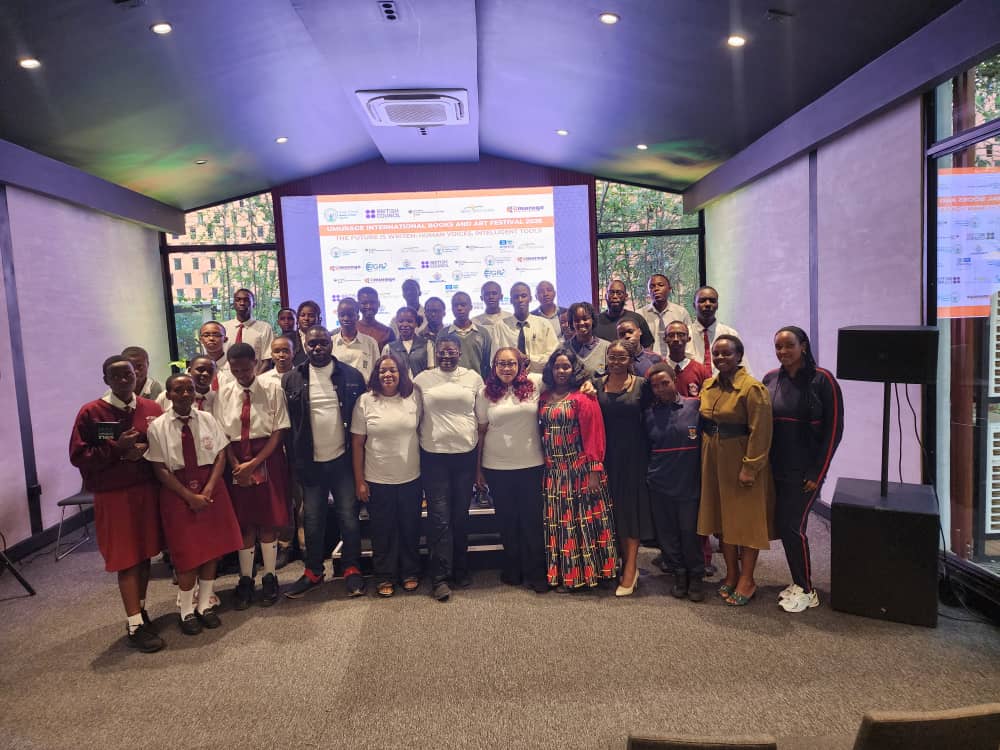
Later, on a panel about the festival theme, he was asked about Artificial Intelligence. He did not equivocate.
“AI is a beautiful monster,” he said.
Beautiful, because of what it can do. Monstrous, because of what it asks us to stop doing: thinking. The danger, he argued, isn’t that AI will become human. It’s that humans will stop being human — that we will outsource memory, imagination, emotion, and then wonder why our voices sound so thin. The tool should amplify the voice, not replace it.
He had a separate session for his own book, Bush Radio — a hundred poems in five movements. He read “Fela,” his ode to Fela Anikulapo-Kuti. But first, he had to explain Fela to Rwandans. He did it the only way that made sense: by quoting him.
“Me and you no dey for the same category.”
For a second, Kigali was Lagos. Fela’s voice, that impossible, insistent snarl, travelled three thousand miles and landed, intact.
Outside the official program, Kigali worked on him in smaller ways. There was Gromyko Amedu, who became, in Osarenren’s phrase, “oil to the wheel” of the whole trip — the fixer, the friend, the man who knows where to go. There was Mount Kigali at dusk. There was AfriNaija Pot and Restaurants, where, Osarenren reports, “we were fed and we became fed up.” There was the Green Carpet in Nyarutarama, a 2.4-kilometre stretch of green rubberized track that loops around the golf course, where the city’s runners orbit like satellites. There was a drive past the heavily guarded Presidential Villa, and the sight of houses clinging to hillsides with a logic that seemed both improbable and inevitable.
And there was the cleanliness. Every visitor mentions it, because you cannot not mention it. Kigali is absurdly, almost aggressively clean. There is no litter. There is order. For Nigerians, who come from a country where order is often treated as a suggestion, it is both inspiring and faintly disorienting.
What Osarenren found in Kigali was not a simple redemption story. Rwanda has not moved past its history; it has learned to carry it differently. From Ashes to Ambition is not just a book title. It is an urban plan.
A nation can remember its wounds without becoming its wounds. A people can inherit history without becoming prisoners of it.
He arrived with poems, questions, and memories. He left with more questions, and a conviction that feels old-fashioned in the age of the beautiful monster: that the poet’s job is to keep listening. To history, to people, to the static in the air, and to give language to the things we must not forget.


Comments