
In Lagos, the 2027 Governorship Race Begins in the Gutter
Election, Climate and Environment
By Oluwaseyi Elizabeth Jimoh
The 2027 Lagos governorship debate was not supposed to be about smell. It was supposed to be about vision.
At the first major debate of the 2027 Lagos governorship race, four candidates tried to explain why the richest city in Nigeria cannot take out its own trash — or keep its own streets dry.
But in Lagos, smell is vision. Or the lack of it.
Onstage — under the lights of Channels Television, TVC, Punch, TheCable and Vanguard — four aspirants were asked to explain why Africa’s largest city still cannot answer a simple question: what do we do with what we throw away?
Gbadebo Rhodes-Vivour, of the African Democratic Congress, gave the evening its line. Lagos, he said, does not have a waste management system. It has a pick-and-dump system.
Under Babatunde Fashola, he recalled, about a thousand trucks collected waste. Now there are about two hundred. Population up, fleet down. The result is a centralised system that has sidelined local governments and failed to build what Rhodes-Vivour called a waste-to-wealth and waste-to-energy value chain. His fix is almost quaint in its simplicity: let households separate waste, let local governments collect it, let different trucks take it to different facilities. Everyone profits.
Dr. Obafemi Hamzat, of the ruling All Progressives Congress, did not deny the mountain of waste. He offered a transition instead: from collection-and-dumping to collection-and-recovery, with facilities at Olusosun and Alimosho. Recover 10,000 units, he said, and the city turns.
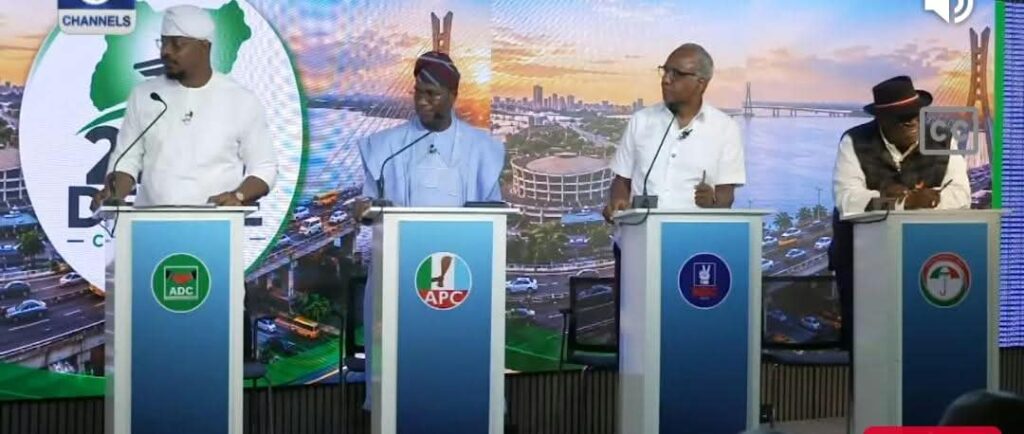
Funso Doherty, of the Nigeria Democratic Congress, was less patient. “As a Lagosian, it is very difficult for me to admit that Lagos is smelling,” he said. “But we certainly have a waste management problem, and again, I will characterise this as a failure of governance.” His diagnosis was practical: not enough trucks, not enough transfer stations, and a long-term recycling plan that exists mostly on paper.
Adedeji Doherty, of the Peoples Democratic Party, added the final complication: waste is not one thing. Solid, liquid, human — each needs its own system. Each is failing.
Then came the water. Flooding, the aspirants agreed, is the other half of the same crisis. Rhodes-Vivour warned against sandfilling Makoko and paving over wetlands, citing Japan and the Netherlands as models of living with water. Hamzat blamed heavier rainfall — up from 2.2 to 2.7 — and promised better evacuation to creeks and lagoons. Doherty blamed building on waterways and questioned whether the Lagos-Calabar Coastal Road ever had a proper Environmental Impact Assessment. Hamzat said it did.
By the end, the voters had not been given a solution so much as a choice of stories: a system badly designed, a system mid-transition, or a system badly governed.
The rain will decide which story is true.


Comments