
Lagos Air: Can I Breath and Live Here?
Lagos promised opportunity. The air had other plans.
A LightRay Environmental Feature Spotlight
By OLUWASEYI ELIZABETH JIMOH
What if the one thing that is supposed to be free — air — comes with a hidden price?
Precious Nwonnu did not expect to be asking that question. She was in her late twenties when she left Enugu State for Lagos, at the urging of a lecturer who told her that the Nigerian Institute of Journalism in Lagos was where serious journalists were made. She spent ten hours on a bus to get there.
The city had other ideas.
As she settled into classes and began commuting through Ojota and along the railway corridor, she learned a new geography of smell: refuse, open drains, open defecation.
“I was on the bus, and I was the only one covering my nose,” she recalled.
What unsettled her more than the stench was its resilience. Sanitation officers would clear the heaps in the morning. By evening, when she returned on the same route, the refuse was back — as if the street itself were producing it.
Then came the coughs. Every two weeks, she fell ill. Clinic visits, medication, brief recoveries, then relapse. Someone told her to boil green tea and lemongrass. She did. It didn’t quite help.
Precious is not alone. That was the question that began to nag at me in 2023, when I too moved from Ondo State to Lagos. Within three weeks, I developed a persistent sore throat that made swallowing painful. At the school clinic, a nurse looked at my throat and said, simply: it might be the environment.
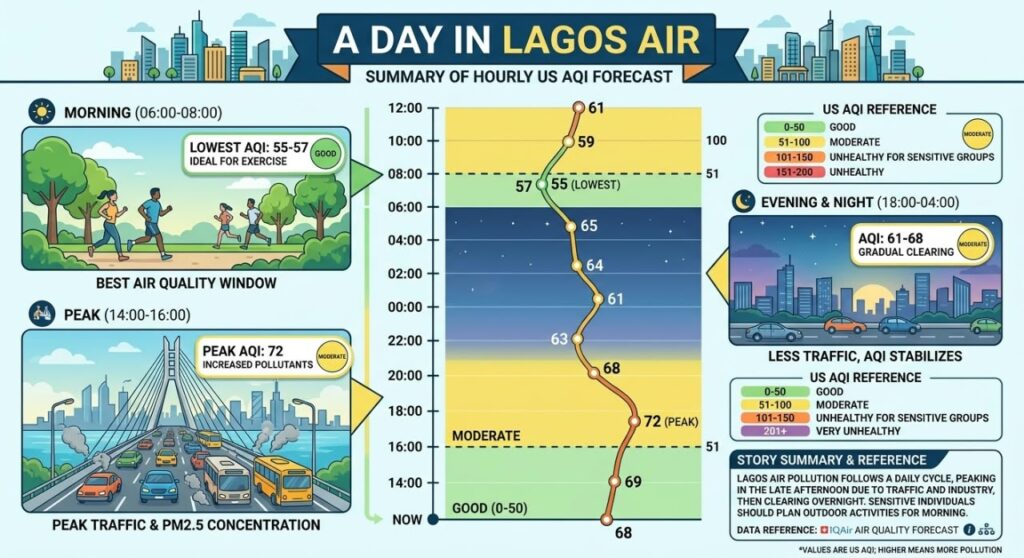
You begin, then, to notice what you previously filed away as “normal city life”: the fine dust that hangs over a traffic jam on Third Mainland Bridge at 5 p.m.; the diesel smoke that settles instead of dispersing; the black bin bags split open on a walkway in Yaba, their contents already migrating toward the gutter.
Is this just adjustment, or is it exposure?
There is a way to ask that question beyond anecdote. But the anecdotes keep coming.
A media specialist and multi-award-winning Social Entrepreneur and Author — who had come to Lagos on a separate assignment — described a similar unravelling. Her concentration slipped. Her breathing grew labored with several hospitalisation every other week. She left the city before her work was done.
“The air I breathed in Lagos was diabolical to my health,” she said. “I almost died. I have never been hospitalised at the rate I was rushed to the hospital almost every other week due to serious air pollution and questionable food stuff sold in the market. “
That is not data. But it is not nothing, either.
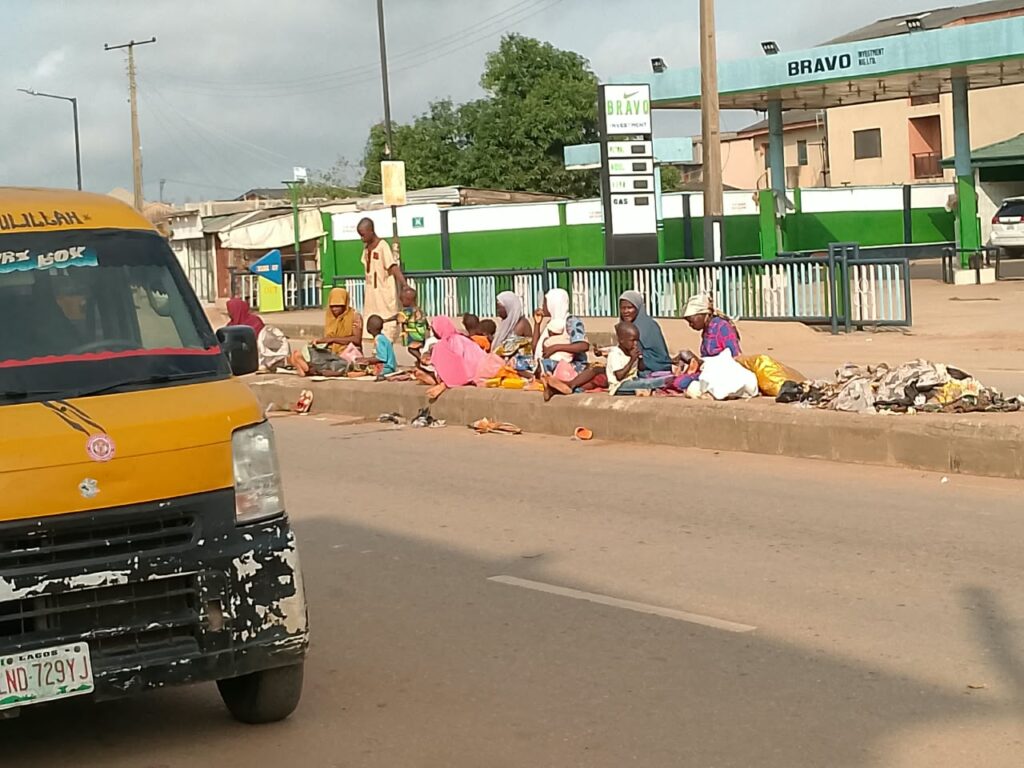
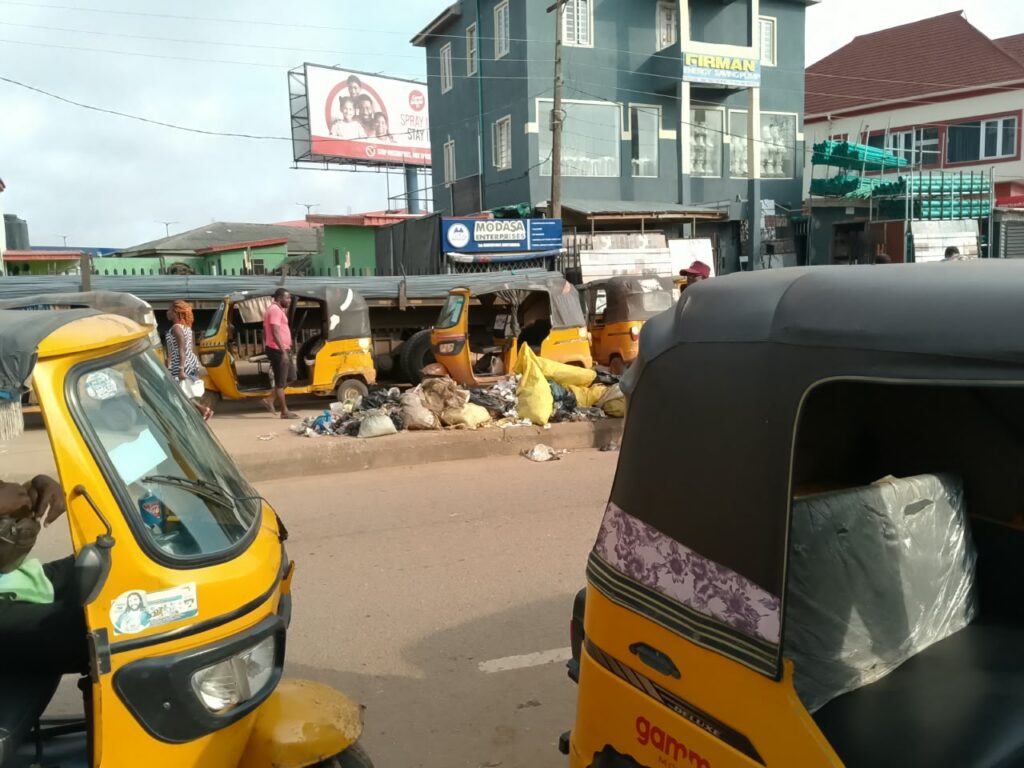
PHOTO: OLUWASEYI JIMOH
The Air, Measured
In August 2026, a team of researchers published a study in ACS ES&T Air that tried to give Lagos air a chemical biography. Over twelve months, from August 2020 to July 2021, they sampled fine particulate matter — PM2.5 — at six sites across the city. PM2.5, particles no larger than 2.5 micrometres, are small enough to travel past the throat and deep into the lungs.
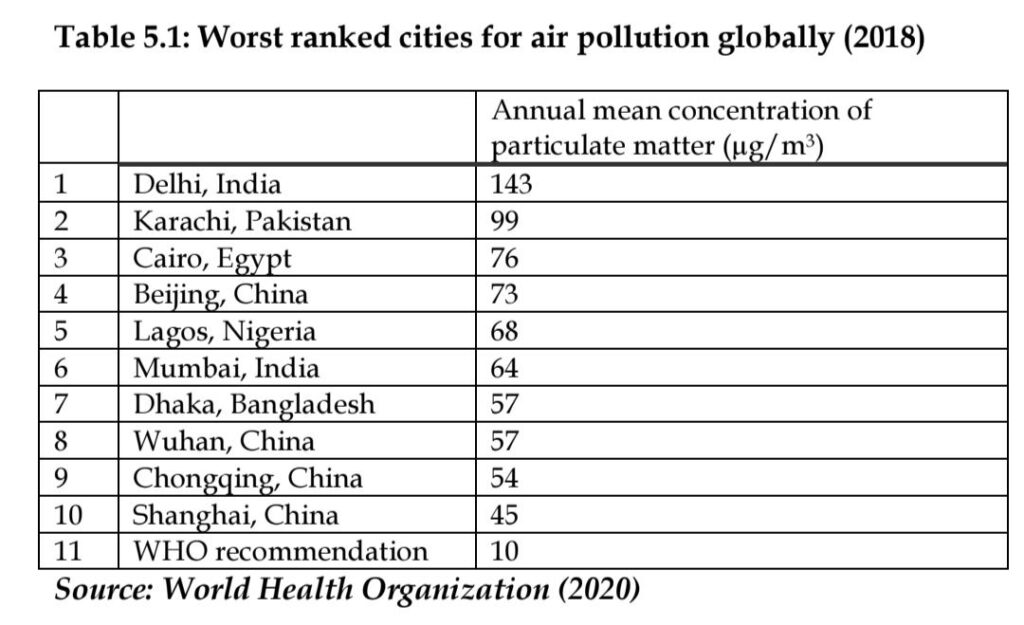
On the most polluted filters — the top 30 percent by mass, which the team chose for detailed analysis — the mean concentration was 68 micrograms per cubic metre. The network-wide annual mean, across all filters, was 47 micrograms per cubic metre. For context, the World Health Organization’s guideline is 5.
Both numbers are high. The distinction matters because they describe different things: one is a portrait of the worst days; the other, the average day. Both are nine to thirteen times what the WHO considers safe.
The study did something else useful: it tried to name the culprits. Dust was the largest contributor. Diesel exhaust was the largest local human-made contributor. Open waste burning accounted for an estimated 8.3 percent. Lead-battery recycling, industrial activity, and other combustion sources made up the rest. Read the full study.
A second paper, published in Atmospheric Pollution Research in 2026, looked not just at particles but at what rides on them — potentially toxic elements. At five of six sites, the total hazard index exceeded one. A hazard index above one does not mean everyone gets sick. It is a screening tool, a flag that says: look closer.
A third study, in Environmental Research in March 2026, examined polycyclic aromatic hydrocarbons — PAHs, formed by incomplete combustion — in PM2.5 and PM10. Its model found that vehicle emissions were the dominant source, and that estimated cancer risks under its assumptions were elevated at all six sites. Again, those are modelled risks, not case counts.
Taken together, they tell a story less about a single smokestack and more about a city’s metabolism: traffic, dust, generators, waste fires, industry — all feeding the same air.
The Waste, Left Behind
Air is only half the ledger. The other half is on the ground.
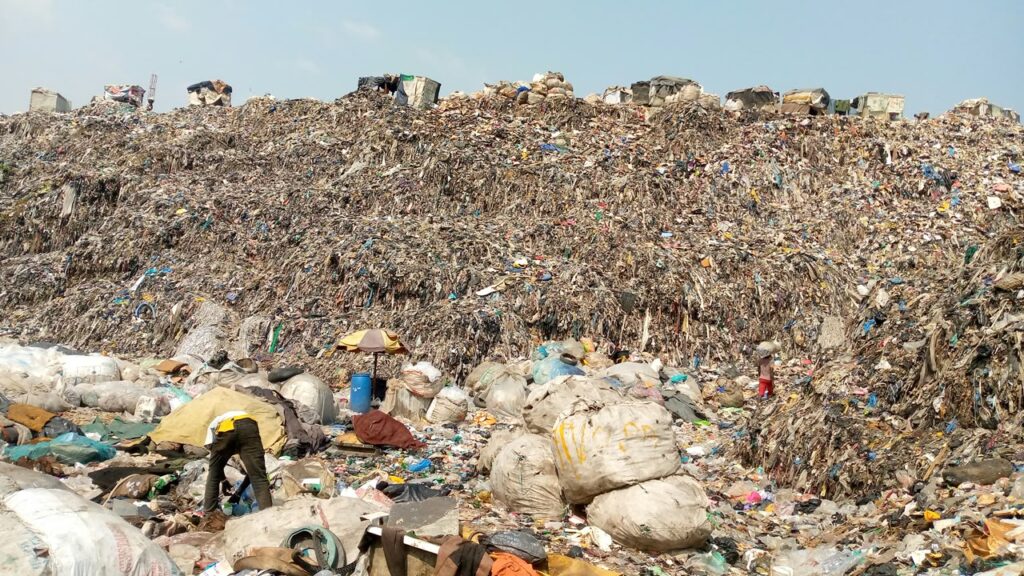
In October 2024, the Lagos Waste Management Authority (LAWMA) said the state, then estimated at 23 million people, was generating about 5.46 million tonnes of waste annually. Collect it, move it, sort it, bury it or burn it — every day, without pause, in a city that never quite stops expanding.
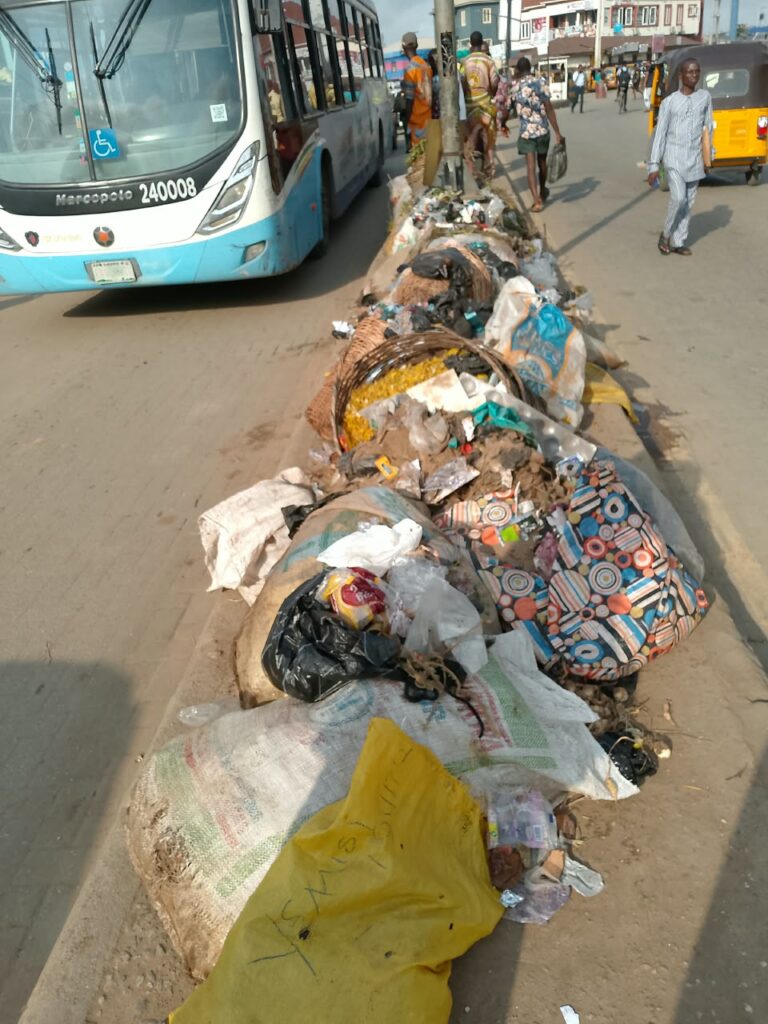
The work is visible when it fails. In markets and on walkways, refuse accumulates. LAWMA’s own video report, Environmental Hazards: Is Lagos Drowning in Waste?, acknowledges the scale of the problem. Watch here.
In September 2026, LAWMA warned that trading on roads, medians and walkways was prohibited under the Lagos State Environmental Management and Protection Law 2017, and said it would enforce against both sellers and buyers. See the Punch report.
That enforcement reveals a tension. A prohibition on dumping does not create a collection route. The availability of a truck does not guarantee compliance. In a megacity, both have to work.
When waste is not collected, it clogs drains. When drains clog, water finds another path. When waste is burned in the open — a common shortcut — it goes up into the same air that already carries diesel and dust. The ACS study listed that smoke as a measurable slice of PM2.5.
Scholars have tried to square the circle. A study by Ajulor, Fajonyomi and Ibikunle, Solid Waste Management in Lagos State… Evaluating the Environmental Impact and Policy Effectiveness of Waste-To-Energy Initiatives, argues for institutional capacity, public awareness, and waste-to-wealth schemes. Waste-to-energy can help, but only with proper technology, emissions controls, and oversight. Otherwise, you solve litter and create air pollution.
Who Owns a Cleaner City?
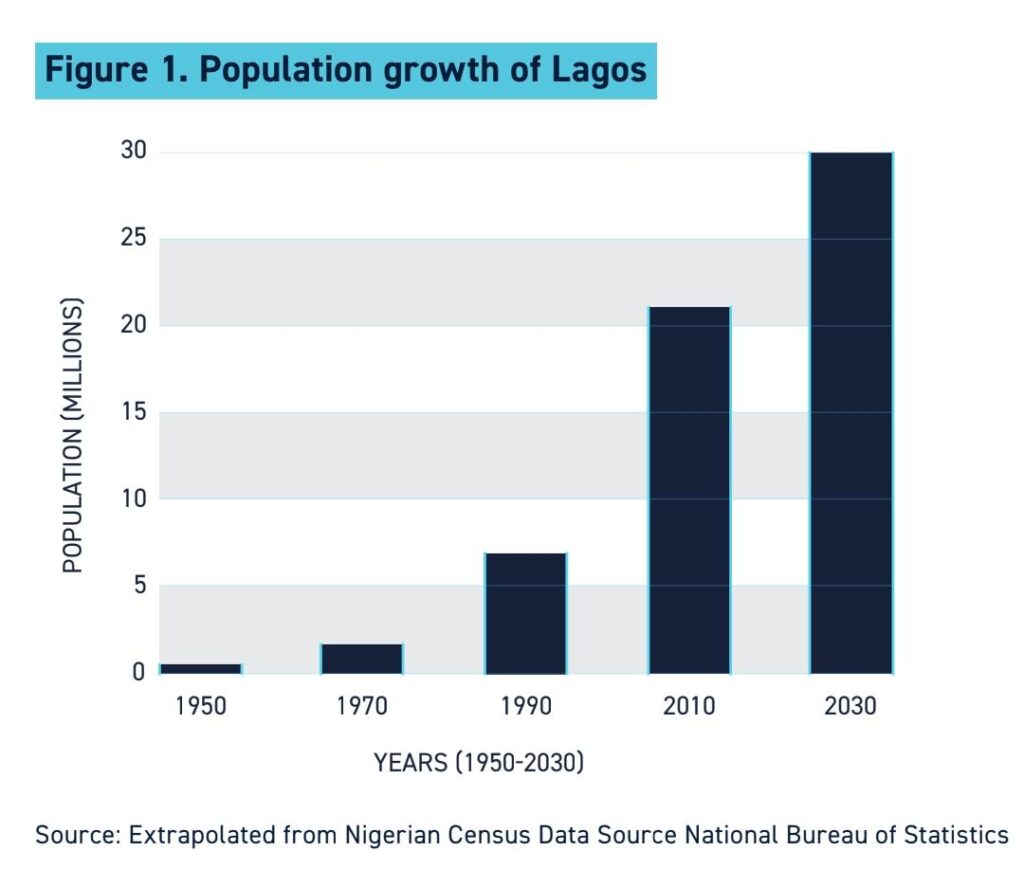
It would be easy to blame newcomers. Lagos is often described as overcrowded, as if people were the pollutant.
A student who grew up in an Army barracks in Lagos put it differently: do not tell people not to come to Lagos. Build a Lagos that can hold them.
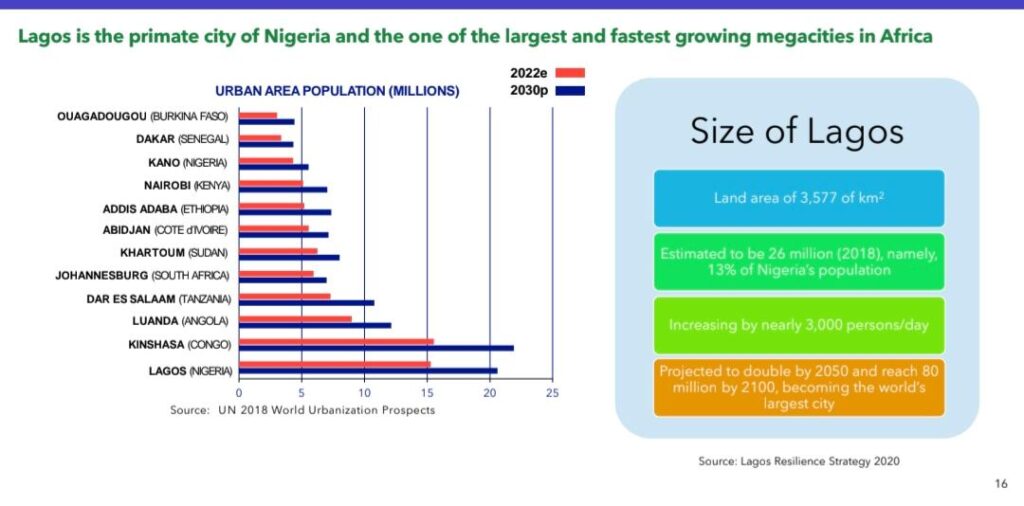
He has a point. The same population that strains housing, transport, sanitation and waste systems also drives the city’s labour, its markets, its music, its newsrooms. Lagos remains Nigeria’s commercial capital long after the political capital moved to Abuja in 1991 — a coastal city of lagoons and creeks, 20 Local Government Areas and 37 LCDAs, capital at Ikeja, still drawing Yoruba, Igbo, Hausa, Efik, Ibibio, and everyone else who wants to try their luck.
The United Nations’ World Urbanization Prospects 2025 frames it globally: cities hold about 45 percent of the world’s 8.2 billion people, and two-thirds of population growth through 2050 will be urban.
The question, then, is not how to stop movement but how to make urban systems keep pace.
Residents have obligations — to use authorized disposal points, to stay off walkways, to comply with emissions standards. Industries have obligations too. And so does the state: to provide reliable collection, drainage, mass transit, and transparent air-quality monitoring that tells a person in Ojota something different from a person in Ikeja GRA, because their exposures are different.
This is where the phrase “planetary health” stops sounding abstract. The health of people depends on the health of the systems around them.
The Cost of Seeking Opportunity
My sore throat eventually passed. Precious still describes recurring illness. The media specialist who came for an assignment left before she could finish hers — her health, she said, gave way.
None of those experiences, on their own, proves causation. But the monitoring data shows that at the places researchers looked, particulate pollution was consistently high, and its sources are identifiable and, in theory, addressable.
Behind every measurement is someone on a bus covering her nose, or boiling lemongrass because the clinic drugs ran out, or leaving a city she came to for work.
Lagos will continue to attract people. It should. The promise is real.
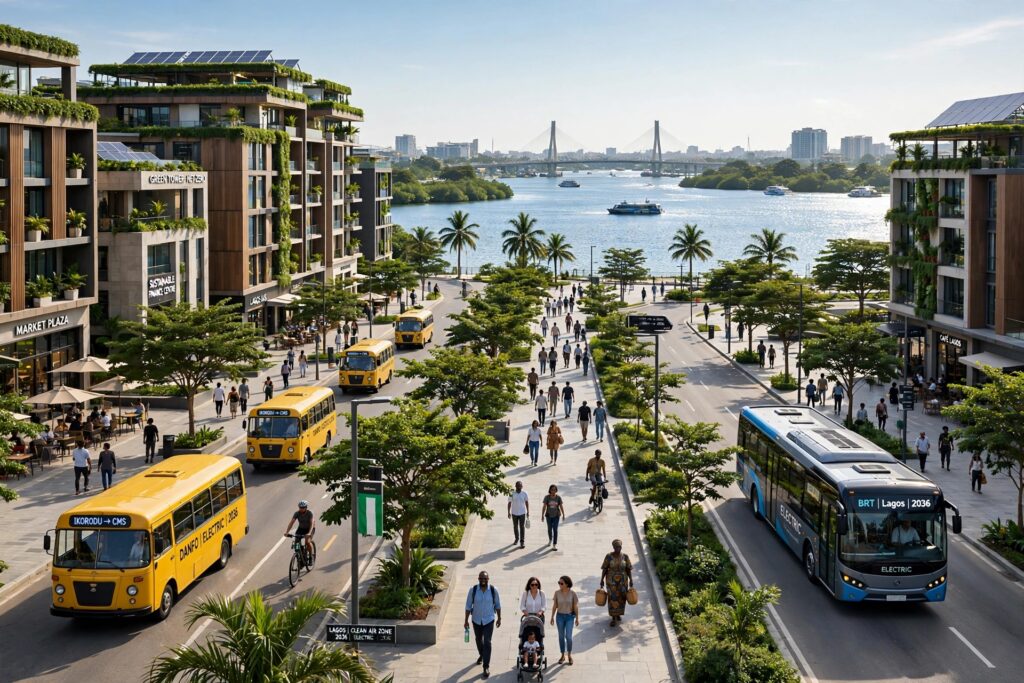
Whether that promise can be kept without asking newcomers to trade their lungs for a livelihood is the city’s most urgent design question. It will require more than policies on paper — it will require collection trucks that come, drains that drain, buses that replace generators, monitors that publish data, and laws that are enforced alongside services that are provided.
A better future should not have to be pursued at the expense of the air needed to live it.


Comments