
Guinea-Bissau Rejects ECOWAS Intervention, Requests Immediate Withdrawal
By Ejiro Umukoro
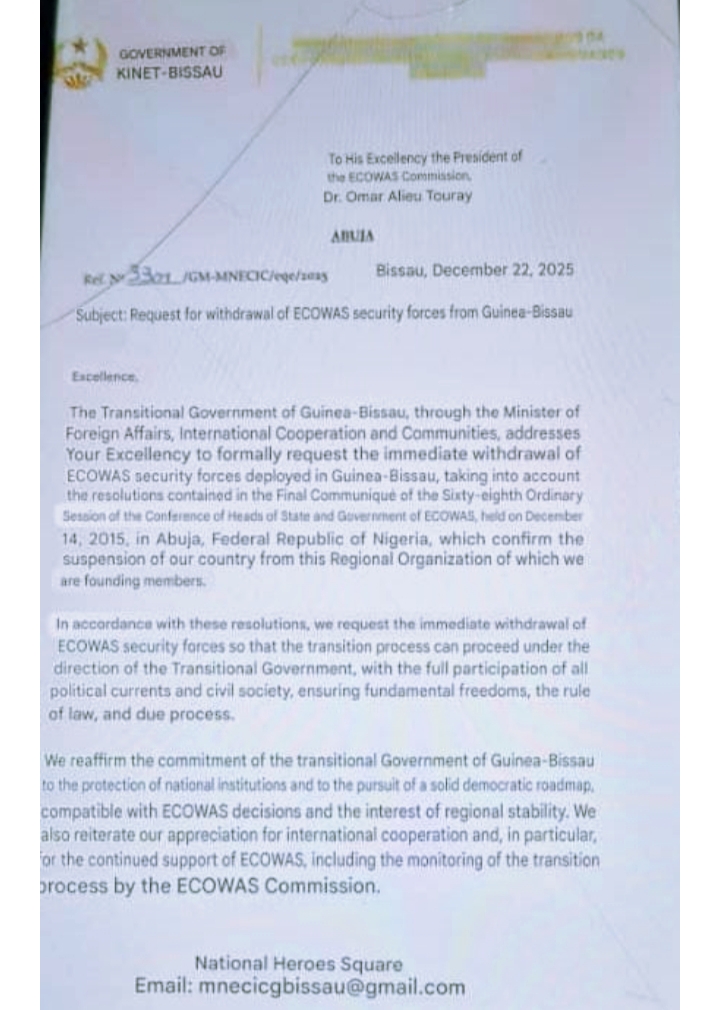
Guinea-Bissau’s military government, led by Gen. Horta Inta-A, has requested the immediate withdrawal of the 500-strong ECOWAS Stabilisation Support Mission (ESSMGB), citing the need for a transitional government to take charge. This move is the latest defiance from the military government following the November 26 coup that ousted President Umaro Sissoco Embalo.
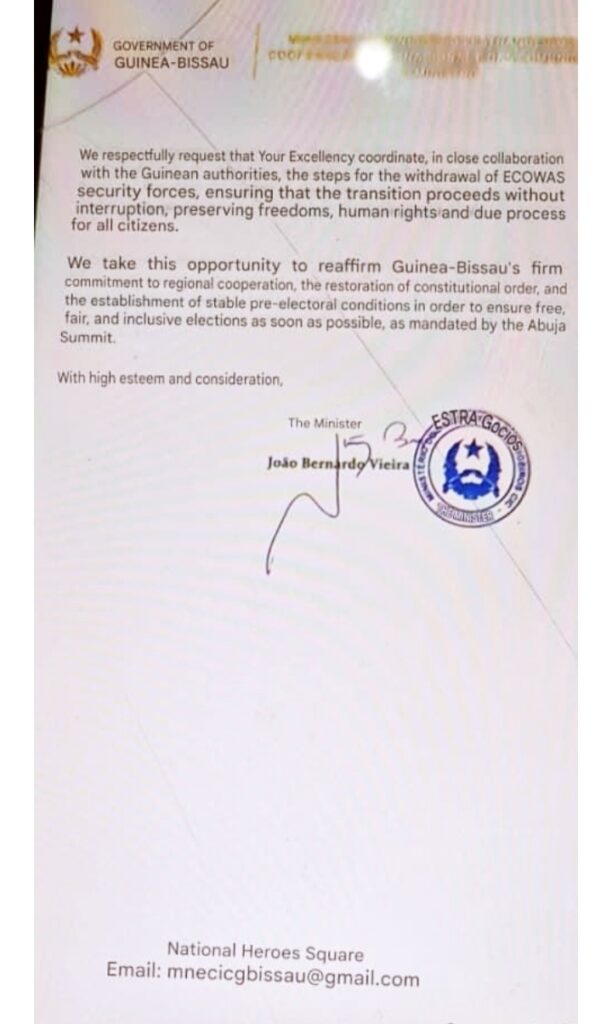
The military government claims the withdrawal is necessary to allow the transition process to proceed with the full participation of all political currents and civil society. However, ECOWAS has rejected the transition plan, demanding a swift return to constitutional order and an inclusive government. The regional bloc has suspended Guinea-Bissau from its decision-making bodies until constitutional order is restored.
In a formal letter to ECOWAS Commission President Dr. Omar Touray, Gen. Horta Inta-A’s administration cited the need for a smooth transition, stating that the withdrawal would enable the Transitional Government to take full control, with the participation of all stakeholders, and uphold fundamental freedoms, the rule of law, and due process.
The move has sparked concerns about democratic backsliding in West Africa, raising questions about ECOWAS’s stance on democratic governance in West Africa, with some arguing that the regional bloc’s response will be a litmus test for its commitment to upholding constitutional order.
While ECOWAS Commission has yet to respond to the request, observers and critics expect a strong stance against the military government, given the bloc’s previous condemnation of the coup. The situation remains tense, with Guinea-Bissau’s political future hanging in the balance.
It will be recalled that ECOWAS has warned of targeted sanctions against individuals or groups obstructing the transition process, including asset freezes, restrictions on commercial transactions, and travel bans within the ECOWAS region. A high-level mediation mission, led by Sierra Leone’s President Julius Maada Bio, has been deployed to engage with the military government.
The regional bloc has demanded the immediate release of all political prisoners, including those detained following the coup, and the institution of a short transition led by an inclusive government. ECOWAS is committed to upholding democratic governance and preventing further erosion of constitutional order in West Africa.
At the 14th December Summit in Abuja, Nigeria, ECOWAS leaders formally endorsed the suspension of Guinea-Bissau following the 26 November military coup, allegedly orchestrated by President Umaro Sissoco Embalo to avoid electoral defeat.
Fernando Dias da Costa, the presidential candidate who claimed victory, has sought refuge in the Nigerian embassy in Bissau, while several opposition leaders remain detained by the military government, despite ECOWAS’s demands for their release. Sources close to the administration indicate that some detainees will face trial.
The ECOWAS summit also called for a “short transition programme,” rejecting the junta’s announced 12-month transition plan, comprising mainly Embalo loyalists, including Gen. Inta-A, former Presidential Guard head, and Prime Minister Ilídio Vieira Té, his campaign director during the 23 November elections. “What ECOWAS leaders have resolved to do is to ensure that there is zero tolerance for unconstitutional change of government,” said Omar Touray, president of the ECOWAS Commission.
The military government, which seized power on 26 November, a day before the National Electoral Commission was set to announce the election results, has solidified its position, appointing a 28-member cabinet to consolidate its grip on power. Diplomatic sources suggest Embalo is secretly directing operations from an undisclosed location. Following the coup, Senegalese authorities facilitated his evacuation to Dakar, then to Congo-Brazzaville, and later to Morocco.
Currently, his wife and associates face charges of smuggling and money laundering in Lisbon, after Portuguese authorities discovered five million euros in a private plane. In 2020, Embalo, having won a disputed presidential election, demanded the withdrawal of the ECOWAS military mission, only to request their return after a reported coup attempt in 2022. His regime has been marked by repression of opposition, civil society, and media, amidst political instability, including four reported coups. ECOWAS had planned to send delegations, but the Horta Inta-A-led administration refused a visit, while receiving a Senegalese ministerial delegation.
Embalo’s past actions, including threats to expel an ECOWAS-UN fact-finding mission, have gone unpunished, emboldening him and other regional leaders to disregard ECOWAS protocols. Five ECOWAS member states are now under military rule, with Guinea planning a transitional election, and Mali, Burkina Faso, and Niger forming the Alliance of Sahel States (AES). Guinea-Bissau’s junta may join AES, which observers warn could destabilize the region and exacerbate the country’s narco-state status.
ECOWAS has invested millions in Guinea-Bissau’s stabilization, including the 23 November elections, but the country’s instability has drained the regional bloc’s resources, with an estimated monthly expenditure of one million US dollars on the ESSMGB mission.
Analysts view the 26 November coup as a self-inflicted wound by Embalo, who underestimated international backlash. ECOWAS faces a daunting task in restoring democracy in Guinea-Bissau and addressing regional authoritarianism.
The situation in Guinea-Bissau remains tense, with the international community, including the United Nations and the African Union, calling for a return to constitutional order. The coup has raised concerns over democratic backsliding in West Africa, with Guinea-Bissau’s coup being the ninth in the region in five years.


Comments